


The different Truck Dimensions: The Complete Guide by Tonnage
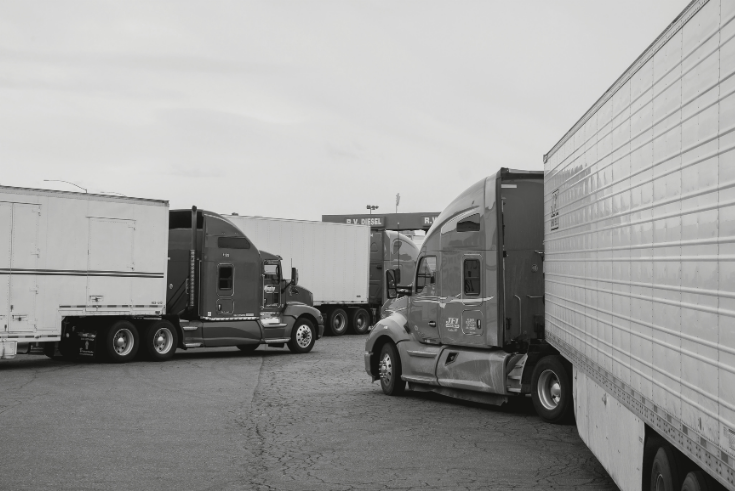
Knowing the precise dimensions of a truck is an essential step before any transport operation. Whether you're trying to determine how many pallets fit in a semi-trailer, or whether your cargo will fit in a 19-tonne rigid truck, this guide provides all the reference measurements you need.
Three main categories of heavy goods vehicles stand out in road transport today: the semi-trailer, the rigid truck, and the light commercial vehicle (LCV) 20m³.
Interior Dimensions vs. Exterior Dimensions: What's the Difference?
Before detailing the figures, it's important to distinguish between two often-confused concepts.
Exterior dimensions refer to the length, width, and height measurements of the vehicle, excluding protruding elements such as mirrors.
Overall dimensions,on the other hand, include these protruding elements. They are used to determine whether a vehicle can fit into a restricted space, underground parking, tunnel, or narrow loading zone.
Interior dimensions, finally, correspond to the usable space available for loading cargo. This is the measurement that determines your actual loading capacity.
The Semi-Trailer: Complete Dimensions
The semi-trailer has established itself as the best long-distance freight transport solution. It refers to the road combination consisting of the tractor unit and the trailer.
Exterior Dimensions (Tractor-Trailer Combination)
- length: 16.50 m
- largeur : 2,55 m (jusqu’à 2,60 m pour les remorques frigorifiques)
- height: 4.00 m
Interior Dimensions (Curtainsider/Tautliner or Box Trailer)
- length: 13.60 m
- width: 2.45 m
- height: 2.70 m
- volume: 90 m³
Interior Dimensions (Refrigerated Trailer)
- length: 13.30 m
- width: 2.42 m
- height: 2.55 m
- volume: 82 m³
Note: rear door opening height may be lower than the actual interior height, generally between 2.50 m and 2.60 m depending on the body type.
Loading Capacity
A standard semi-trailer can hold 33 to 34 pallets of 80x120 cm, or 26 pallets of 100x120 cm.
The 19-Tonne Rigid Truck: Complete Dimensions
More compact than a semi-trailer, the 19-tonne rigid truck consumes less fuel and can access locations where semi-trailers cannot. It is widely used in industrial collection and for deliveries to tight-access locations.
18-Pallet Configuration
- interior length: 7.50 m
- interior width: 2.45 m
- interior height: 2.40 to 2.50 m
- volume: approximately 44 m³
- exterior length: 10 m
21-Pallet Configuration
- interior length: 8.50 m
- interior width: 2.45 m
- interior height: 2.40 to 2.50 m
- volume: approximately 51 m³
- exterior length: 11.5 m
Note: in its refrigerated version, the unladen weight of the 19T rigid truck is higher, which reduces available payload capacity. It is essential to always consider payload capacity alongside dimensions.
The 26-Tonne Rigid Truck: Complete Dimensions
The 26-tonne rigid truck has a chassis that directly carries the body, most often fixed. It is frequently found in refrigerated versions for urban delivery, thanks to its good loading capacity.
18-Pallet Configuration
- interior length: 7.50 m
- interior width: 2.45 m
- interior height: 2.40 to 2.50 m
- exterior length: 10 m
- hauteur extérieure : jusqu’à 3,80 m (parfois 4,00 m selon carrossage)
21-Pallet Configuration
- interior length: 8.40 to 9.00 m
- interior width: 2.45 m
- interior height: 2.40 to 2.50 m
- exterior length: 11.5 m
The Light Commercial Vehicle (LCV) 20m³
Designed to remain within the light vehicle category, the 20m³ LCV does not require a heavy goods vehicle license. It is widely used for home delivery and moving services.
Interior Dimensions
- length: 4.20 m
- width: 2.10 m
- height: 2.20 m
Exterior Dimensions
- length: 6.80 to 7 m
- width: 2.10 m
- height: 2.90 to 3.25 m
Its payload capacity remains limited, generally between 700 and 1000 kg depending on equipment (tailgate lift, etc).
Summary Table: Dimensions by Truck Type
Vehicle Type | Interior Length | Interior Width | Interior Height | Volume | 80x120 Pallets |
Curtainsider (Tautliner) / Box Semi-Trailer | 13,60 m | 2,45 m | 2,70 m | 90 m³ | 33 |
Refrigerated Semi-Trailer | 13,30 m | 2,42 m | 2,55 m | 82 m³ | 33 |
Tractor-Trailer Combination | Max overall length: 16.50 m · Max height: 4.00 m · Max width: 2.55 m | ||||
19T Rigid Truck — 18 pallets | 7,50 m | 2,45 m | 2,40-2,50 m | ~44 m³ | 18 |
19T Rigid Truck — 21 pallets | 8,50 m | 2,45 m | 2,40-2,50 m | ~51 m³ | 21 |
26T Rigid Truck | 8,50-9,50 m | 2,45 m | 2,40-2,50 m | ~55 m³ | 21-24 |
Why These Dimensions Are Essential to Know
Before any transport, these figures allow you to anticipate:
- the number of vehicles required based on cargo volume
- the feasibility of a full or partial load
- access constraints (urban areas, loading docks, clearance height)
- transport cost optimization by avoiding an oversized vehicle
It is important to always refer to the manufacturer's official specifications, as dimensions may vary slightly depending on the bodybuilder and model.
For a complete overview of truck types (curtainsider/tautliner, flatbed, refrigerated, tanker...) and cases requiring special transport, see our article: Types of Transport Trucks : Dimensions and Complete Guide.
Vincio Equipment & Services Support
At Vincio Equipment & Services, we leverage our technical expertise to guide you toward the vehicle with the most suitable dimensions for your cargo, taking into account volume, weight, and access constraints.
Our goal is to optimize every shipment by avoiding oversized or undersized vehicles, ensuring a reliable and cost-effective logistics solution.
Conclusion
A truck's dimensions cannot be reduced to a single figure. Length, width, height, usable volume, and payload capacity must all be assessed together to ensure efficient and secure transport.
A solid understanding of these standards allows you to anticipate your logistics needs and avoid surprises on loading day.