


EUR.1 Certificate: A strategic issue that is sometimes underestimated
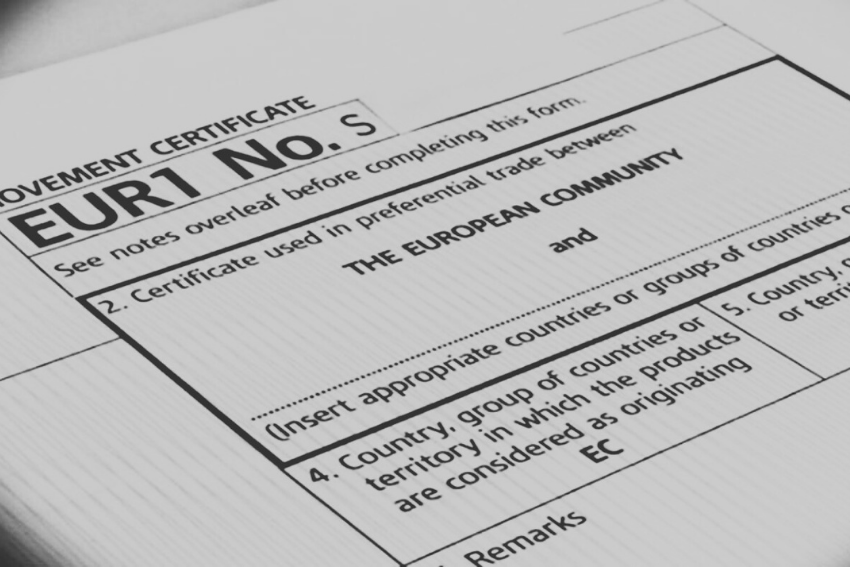
A Regulatory Reminder with Increasing Operational Impact
The EUR.1 certificate is used to certify the preferential origin of goods, enabling reduced or zero customs duties upon import into the destination country, in accordance with applicable free trade agreements.
From a regulatory standpoint, the fundamental principles remain unchanged:
- Preferential origin is never automatic
- It must be demonstrated in accordance with the rules defined by each agreement
- The burden of proof lies solely with the exporter
What is evolving today concerns the timing and level of justification required. Customs authorities now expect that all supporting elements demonstrating preferential origin be available and presented at the time of the EUR.1 certificate endorsement request.
In the absence of sufficient supporting documentation, endorsement may be refused—regardless of the actual industrial or commercial origin of the goods.
Poor control over preferential origin can lead to denial of tariff benefits, customs reassessments, and ultimately a loss of international competitiveness.
Preferential Origin: Full Responsibility of the Exporter
One of the key points emphasized by authorities is the exporter’s responsibility. Exporters must be able to demonstrate, without delay, that the exported goods comply with the rules of origin defined in the applicable agreement.
This responsibility goes beyond the declaration itself and includes:
- Consistency of commercial and technical information
- Traceability of sourcing
- Mastery of applicable rules of origin
- Ability to provide reliable and documented evidence
In this context, a supplier invoice or a simple statement of origin is not sufficient proof. Only structured, consistent, and traceable documentation is likely to be accepted.
Supporting Documents to Be Prepared in Advance
The documents required to justify preferential origin vary depending on the nature of the goods and the operations performed. They may include:
- Supplier declarations (single or long-term)
- Purchase and sales invoices
- Customs tariff classifications
- Product technical sheets
- Manufacturing records
- Value-added or sufficient processing calculations
Beyond their existence, authorities place particular importance on immediate availability, consistency, and traceability.
In practice, this requires rigorous document management and anticipation well in advance of export flows.
Shipment Value and Alternatives to the EUR.1 Certificate
Pour les exportations d’une valeur inférieure ou égale à 6 000 €, le certificat EUR.1 n’est pas obligatoire.
L’origine préférentielle peut alors être déclarée directement sur la facture ou sur un document commercial équivalent, via une déclaration d’origine sur facture.
Cette simplification apparente ne remet toutefois pas en cause la responsabilité de l’exportateur, qui doit rester en mesure de justifier l’origine préférentielle en cas de contrôle.
Pour les flux d’un montant supérieur ou réguliers, le statut d’Exportateur Agréé constitue une alternative structurante. Il permet d’établir des déclarations d’origine sur facture sans limitation de valeur, sous réserve d’une maîtrise complète des règles d’origine et d’une organisation documentaire adaptée.
Preferential Origin: A Cross-Functional Issue in International Projects
In industrial projects and global supply chains, preferential origin can no longer be treated as an isolated or last-minute constraint.
It lies at the intersection of procurement, engineering, logistics, and regulatory compliance.
The multiplication of stakeholders suppliers, manufacturers, freight forwarders, and end customers increases the risk of information gaps and inconsistent interpretations. In this context, structuring flows and coordinating exchanges become key levers for securing operations.
VINCIO: A Facilitator at the Heart of International Flows
As a procurement facilitator, VINCIO operates at the intersection of technical, logistical, and documentary aspects of international projects.
Our role includes :
- Structuring international sourcing flows
- Centralizing information and documentation from suppliers
- Ensuring consistency between project requirements and implemented solutions
- Highlighting applicable regulatory constraints
- Facilitating coordination with specialized partners when needed
This approach helps reduce uncertainty, anticipate critical points, and contribute to smoother operations without replacing regulatory authorities.
Our Practical Support for EUR.1 Certificates and Origin Documents
As part of our commitment to optimizing flows and ensuring regulatory compliance, we support the implementation of EUR.1 certificates:
- Either directly through VINCIO
- Or via our network of partner freight forwarders
We assist our clients with this strategic documentation requirement, enabling them to:
- Fully benefit from tariff advantages
- Avoid additional costs linked to missing proof of preferential origin
- Secure their customs operations
Our approach is based on three key pillars:
- Compliance Verification We analyze available elements to ensure compliance with origin rules.
- Risk Identification
Clients may not always know whether their products meet preferential origin criteria, or may assume compliance without adequate documentation. We identify these situations in advance. - Proactive Solutions
Depending on the destination of goods and countries of origin, we propose:- The issuance of an EUR.1 certificate
- Or alternative documents under applicable cooperation or free trade agreements
This proactive approach not only secures flows but also optimizes customs costs and strengthens the competitiveness of international projects.
Conclusion
The renewed focus on EUR.1 movement certificates reflects a broader evolution in customs practices: while the regulatory framework remains unchanged, authorities are increasing their operational requirements.
For internationally active companies, this evolution requires greater anticipation, structured information management, and better integration of preferential origin considerations from the early stages of projects.
In this context, having a partner capable of coordinating flows, structuring exchanges, and connecting stakeholders becomes a key factor in securing operations.
Origin should no longer be addressed at the end of the chain, but from the very beginning of project structuring.
This is the approach embraced by VINCIO, providing a global vision and operational continuity to support industrial and commercial projects whatever the international context.